Measure Before You Buy
Drawer Organization Systems: Measure First, Then Choose a Layout
Measure the usable drawer box and the items that must fit before choosing fixed trays, adjustable dividers or modular bins.
Published by Dwelling Notes
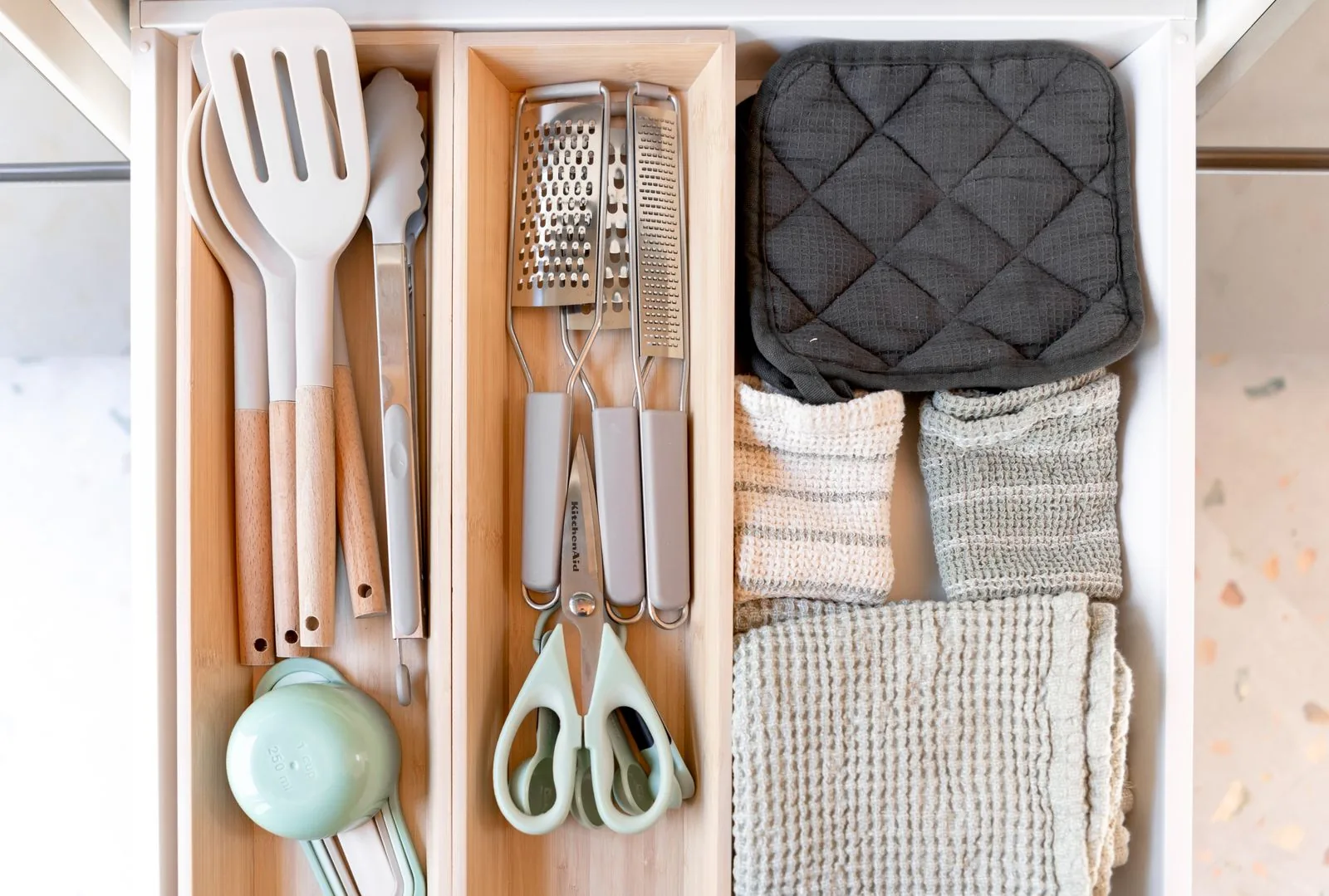
A drawer can look wide from the outside and still have much less usable space inside.
The front panel may be larger than the drawer box. Interior corners can be rounded. Rails, screw heads or construction details can reduce usable space. Tall tools can fit the footprint but prevent the drawer from closing.
That is why a drawer organizer should be chosen from the usable drawer box and the items that actually need to live there, not from the label on the cabinet front.
Give the drawer one clear job
Start with one drawer at a time.
Empty it and decide what the drawer is supposed to contain.
Examples:
- everyday cutlery;
- cooking utensils;
- food-prep tools;
- coffee accessories;
- office supplies;
- bathroom grooming items.
If the drawer has become a mix of unrelated items, separate the categories before measuring organizer layouts.
An organizer cannot fix a drawer whose job is undefined.
Measure the inside width
Measure the usable interior width of the drawer box from side to side.
Do not use the width of the decorative front panel.
Record:
USABLE INSIDE WIDTH = ______
If the sides are not perfectly straight or an internal feature reduces the opening, record the narrowest relevant dimension.
Measure the inside depth
Measure from the usable front interior surface to the usable back interior surface.
Record:
USABLE INSIDE DEPTH = ______
Watch for curved corners, fasteners or other features that could prevent a rigid tray from sitting flat.
Measure usable height
Measure from the drawer bottom to the lowest point that controls closure.
The visible front panel height may not equal the usable height inside the cabinet.
Record:
USABLE HEIGHT = ______
Then look at the tallest item you expect to store.
A long spoon can fit the footprint but still sit too high if the handle curves upward.
Measure the items, not just the drawer
Now inventory the contents.
Record the longest or widest item that must fit in each intended section.
Examples:
- longest cooking utensil;
- widest serving tool;
- diameter of small jars or containers;
- size of a grouped cutlery set;
- dimensions of frequently used accessories.
The organizer should serve the contents. Do not remove useful items simply because a pre-made tray has the wrong compartment pattern.
Compare three layout classes
Fixed insert
A fixed insert has a predetermined footprint and compartment arrangement.
It can work well when the measured drawer closely matches the tray and the contents match its section sizes.
The limitation is rigidity. If the longest item is too long or one compartment is poorly proportioned, the whole tray may waste space.
Before choosing a fixed insert, compare its exact manufacturer dimensions with the drawer box, not the drawer front.
Adjustable dividers
Adjustable dividers let you create longer and shorter zones around the items you own.
This can be useful for mixed-size tools.
Exact expansion range, attachment method and material claims are product-specific and should be verified from the manufacturer for any future recommendation.
Modular bins
Small modular bins allow the layout to be rearranged.
They can work when the drawer contains several compact categories or when the contents change over time.
The tradeoff is that many small bins can consume space through repeated walls and gaps, so test the footprint before buying a full set.
Leave room to lift items out
A perfect top-view fit can still be frustrating if items are packed so tightly that they cannot be lifted naturally.
When testing a layout, use the drawer as you normally would.
Can you:
- pick up the longest utensil without moving another section?
- return an item without forcing it under a divider?
- remove a bin for cleaning?
- see the category at a glance?
Do not optimize only for maximum item count.
Usable access matters more than filling every square inch.
Separate daily tools from duplicates
A drawer becomes crowded quickly when duplicates and rare-use tools share the easiest positions with daily items.
Create two groups:
- daily or weekly tools;
- duplicates and rare-use items.
If the second group does not need immediate access, consider another storage location before purchasing a larger organizer.
This can reduce the number of compartments the drawer actually needs.
Test the layout with paper before buying
A simple paper or cardboard mockup is useful for rigid inserts and modular-bin layouts.
Cut rectangles to the published footprint of a candidate organizer or sketch the intended sections directly on paper.
Place the template in the drawer and set the real items on top.
Check:
- longest-item fit;
- section widths;
- unused gaps;
- access to daily tools;
- whether the layout leaves enough room for natural removal.
This does not test product strength, durability or fit tolerances. It is only a geometry check.
Recheck drawer closure
Before treating a layout as final, close the drawer slowly with the tallest items in their intended positions.
Do not force a drawer that catches.
If the drawer contains stackable bins or tall utensils, the full loaded height matters.
Any exact product’s dimensions and installation requirements should be verified from its current manufacturer information.
Run a one-week reset test
Use the layout for about a week before assuming every compartment is necessary.
Watch for sections that become catch-alls.
Ask:
- Which section stays organized naturally?
- Which one fills with unrelated items?
- Which tool is always returned to the wrong place?
- Which compartment is mostly empty?
Adjust the layout based on behavior rather than adding more sections.
Drawer measurement card
Record:
- Inside width: ______
- Inside depth: ______
- Usable height: ______
- Interior obstruction: ______
- Longest item: ______
- Widest item: ______
- Tallest item: ______
- Daily-use category: ______
- Rare-use items relocated if appropriate: YES / NO
System comparison:
- Fixed insert fits measured drawer: YES / NO / NOT CHECKED
- Adjustable-divider layout mapped: YES / NO
- Modular-bin footprint mapped: YES / NO
- Drawer closes with tallest intended contents: YES / NO